
How a Developer Built an AI Front Office with Akapulu Labs in a Weekend
One scenario, four specialist avatars, and a handoff that doesn't lose context. A look at what's buildable with Akapulu Labs today.
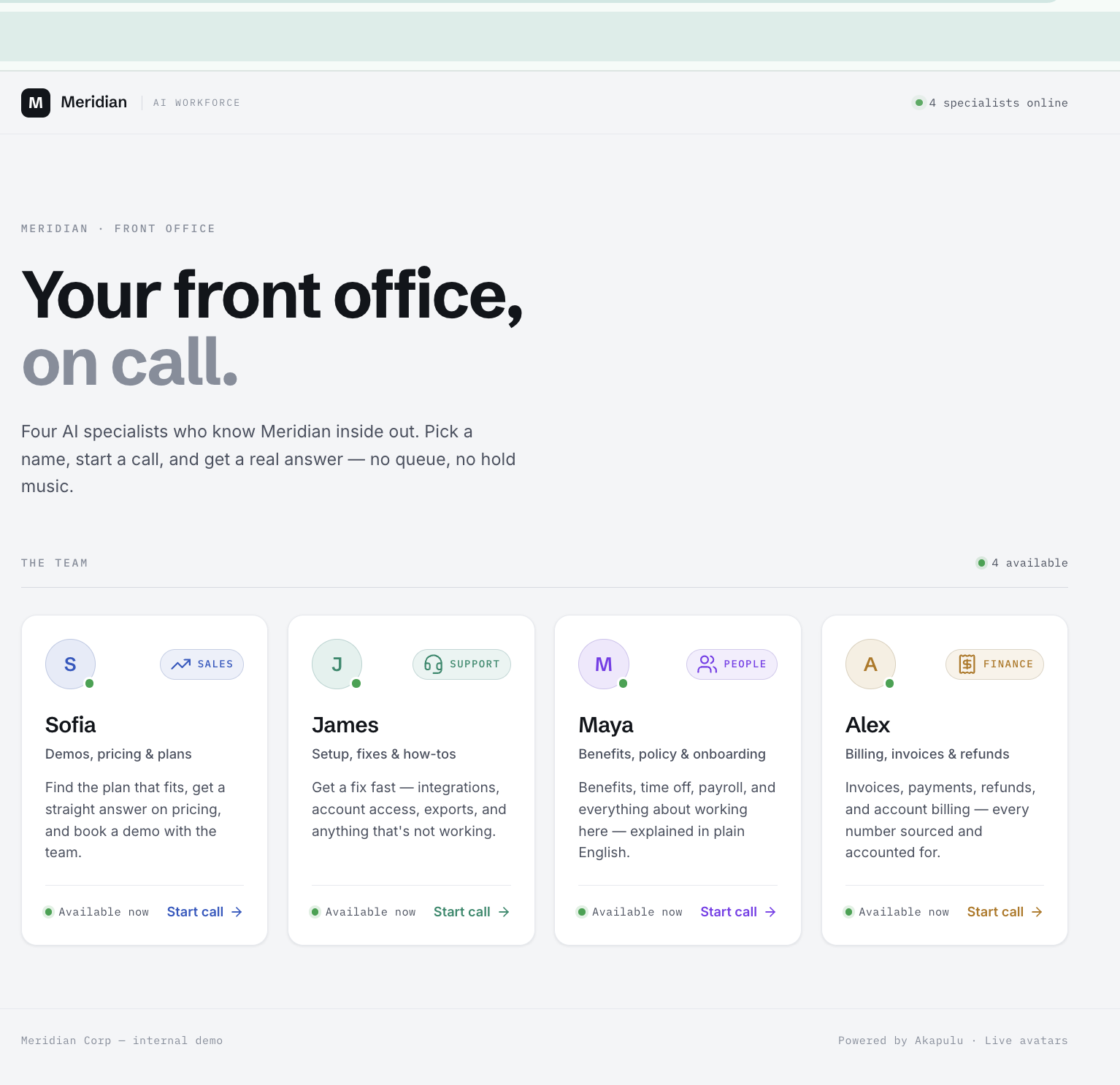
We love seeing what people build with Akapulu Labs, and this one stopped us in our tracks. Over a single weekend, developer Mustafa Khan built a full AI "front office": a company's entire customer facing team, run by real time conversational avatars, one specialist per department. Here's how it works, and why we think it's a glimpse of where conversational AI is headed.
What happens when you get transferred?
Anyone who's called a support line knows the pain. You explain your problem to one person, get transferred, and then have to explain the whole thing again to the next. Most systems drop all of that context the moment a call moves between departments.
That's the exact gap Mustafa set out to close, and the result is a surprisingly complete demo he calls Meridian, after the fictional company it serves.
Four specialists, one front desk
Meridian Corp has four department avatars, each with its own face, personality, and deep knowledge of its lane:
- Sofia (Sales): demos, pricing, and plans
- James (Support): setup, fixes, and how to guides
- Maya (People): benefits, policy, and onboarding
- Alex (Finance): billing, invoices, and refunds
Pick a department on the landing page, start a video call, and you're talking to a specialist who stays firmly in their lane.
One scenario, many personas
Here's the part we love: all four avatars run on a single Akapulu scenario. The name, role, and department knowledge are injected per call through runtime variables. Change a few values and Sofia in Sales becomes Alex in Finance. Same underlying logic, a completely different specialist.
It's the same pattern we use for everything from sales roleplay to customer intake: build the conversation once, then point it at any persona you need. Mustafa just pointed it at a whole org chart.
How do you hand off without losing the thread?
This is the clever bit. Each avatar only handles its own domain. Ask Sofia in Sales a billing question, and instead of fumbling it, she says "let me connect you to the right person," then transfers you to Alex in Finance.
Crucially, the conversation so far gets carried along. Mustafa pulls the prior call's transcript and feeds it into the next avatar as context the moment the new call connects, so Alex already knows what you discussed with Sofia. No starting over. No repeating yourself.
An honest note: today this works as an "end and reconnect." One call wraps up and a fresh one begins with the context carried over. It doesn't happen seamlessly within a single call yet, but it's a clever use of the primitives available right now, and it solves the real problem: the caller never has to repeat themselves.
Real answers, not guesses
Each avatar is also backed by a shared knowledge base. Detailed questions like pricing tiers, support SLAs, and refund policy get answered from a real company knowledge base using a RAG tool. So the avatars give accurate, sourced answers instead of making things up on the spot.
Why this matters
What makes Meridian exciting isn't any single avatar. It's the coordination between them. Mustafa, who works on multi agent systems at Coral, put it well:
"The coordination is more interesting than the agents themselves."
And the whole thing came together in a weekend, on primitives that every Akapulu developer has today: runtime variables, transfer logic, a knowledge base, and recorded real time avatars. No special access, no custom infrastructure. Just the building blocks, composed in a new way.
Build your own
Meridian is a great example of what happens when you treat avatars as composable building blocks instead of standalone bots. If it sparked something, the same primitives are all in our docs, and you can spin up your first avatar in minutes.